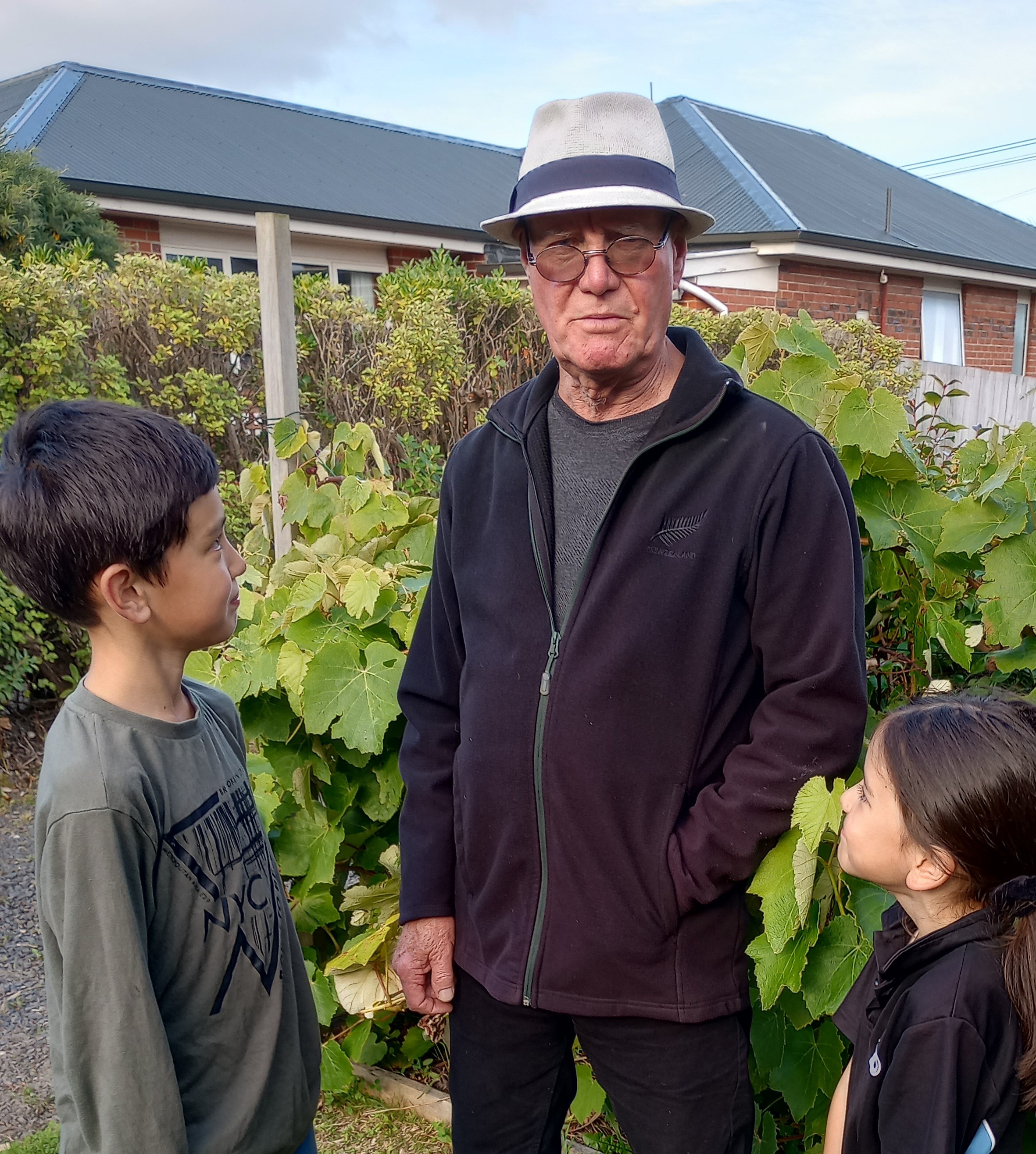
Meet Vic from Dunedin, New Zealand
Who am I?
I feel that this phrase works better as a question than as a statement because even at the age of eighty, I don’t feel as if I am a ‘finished job’. While working currently as an artist, I am still pushing my own conceptual and technical boundaries out into new territory. Hold that thought for the moment.
I am a migrant, and I feel privileged to live in and be a citizen of Aotearoa. As this is my chosen home, I am dedicated to its whenua, its peoples, and its mana. I hold community as important to me and I love my place in Otepoti, Dunedin.
My childhood and youth in Great Britain gave me principles which have guided my attitudes and actions through the years, and political instincts have seasoned these. Frugality, respect for and delight in nature, care and respect for the environment, impatience with waste, aggression, violence, acquisitiveness, greed and, in particular, injustice through sexism, racism, and the consequences of inequality.
I would like to think that members of SCAN would embody many, if not all of these traits. These, however, are personal attributes and our group is a community motivated by hope and conviction that the increasingly menacing predicament of planetary collapse need not be inescapable.
The dark days of total climate denial are fading and most people on earth are either experiencing the effects of climate change personally or have acknowledged that a problem needs to be addressed and some measures adopted. People are often motivated by concern for family, and it’s not a bad place to start. I for one am fearful of the prospects for my mokopuna for lives of purpose, balance, and happiness when they reach my age. By that time, sea level rise alone will be flooding the lower reaches of the cities and countryside of Aotearoa, let alone Bangladesh or New York. These prospects leave many people bewildered and caught like animals in headlights not able to see a way out of danger. But I believe that everyone can make personal changes or adopt a range of practices that collectively can make a difference. Of course, in this war with future catastrophes ranged against us, nations, cities, and corporations must be the front line. But personal changes in the way we work, communicate, travel, feed ourselves, discard things, and many more thoughtful ways of living must be on the ‘home front’.
Below is a list of thoughtful ways of living that I have adopted, pledged, or am working towards. I am not alone in this, of course, and here are details of a new climate movement called “The Jump” to persuade and support relatively well-off people to remake and sign up to the six pledges. Tom Bailey, co-founder of the campaign said: “This ends once and for all the debate about whether citizens can have a role in protecting our Earth. We don’t have time to wait for one group to act, we need all action from all actors now”.
The Jump campaign asks people to sign up to take the following six shifts in lifestyle for one, three or six months:
- Eat a largely plant-based diet with healthy portions and no waste.
- Buy no more than three new items of clothing per year.
- Keep electrical products for at least seven years.
- Take no more than one short haul flight every three years and one long haul flight every eight years.
- Get rid of personal motor vehicles if you can and if not, keep hold of your existing vehicle for longer.
- Make at least one life shift to nudge the system, like moving to a green energy, insulating your home, or changing pension supplier.
Now, some of these things cost money, but some save money, so personal economies will make a difference. Thanks to my modest resources growing up, I have always had thrifty ways. Because I am retired from work, I am time rich. I find that engagement with my community is very rewarding and I volunteer in a number of ways. So here is a list of my exemplary activities:
I take personal responsibility for my own health.
Respect your body’s limits and follow guidelines from a source you trust, for example your doctor or responsible journalism. Avoid risk in gardening and domestic work - who needs to fall off the roof or slip over on a wet floor?
We eat a largely plant-based diet, with healthy portions and no waste.
Our red meat intake is occasionally stewed beef or lamb in pies. Chicken is free-range and an occasional treat. The only consumption of beef steaks is a Christmas treat once annually. We have a low-waste policy with food, making use of the freezer and fridge for leftovers. Fruit and vegetable scraps are composted and are used to fertilise garden beds. We eat fruit and vegetables grown on our own section - window boxes, an old bath, garden beds, anywhere. We are experimenting with permaculture in our vegetable growing.
Find ways to repair, reuse, repurpose or recycle all unwanted possessions before choosing to discard them. Buy fewer clothes. Recycle appropriately.
We must attempt to respect planetary boundaries and not needlessly waste manufactured goods when they still have some useful life. We use a local ‘buy nothing’ App to offer stuff into the community or beyond. We often look for clothes, tools etc. in op shops. Never waste food; refrigerate or freeze to conserve. Recycling containers contaminated with their contents is pointless and usually results in the entire bin being rejected. Take the lids off wine bottles. Take care to recycle batteries appropriately, as they contain rare and expensive minerals which will be vital for future needs. An important centre for this is the recycling shed at the landfill site. Recycle soft plastics in supermarkets or The Warehouse.
Conserve energy and take responsibility for personal carbon emissions.
As I write this, I turn and can see from my window a bright light on a neighbour’s garage which has been burning relentlessly for years, day and night. This seems to me to be either pure laziness or senseless over-consumption. As increasing numbers of people are choosing to switch their personal transport to an electric car, I am finding it irksome that others find it the right time to invest their money in a gigantic SUV or Ute, seemingly to burn as much fossil fuel as possible before it is all used up. I see this as senseless and irresponsible consumption and lack of vision. I don’t know about anyone else, but I feel like we are on the offensive against emissions greenhouse emissions which are creating dangerous climate change. Wars are won by offensive action, and some people are deliberately buying a three or four litre fossil-propelled block of steel with an empty box at the back, just to do a school run or go to the supermarket. How would this action have gone down in the two World Wars?

Things we have changed over the years that have contributed to power saving are:
- Retrospective double glazing of our windows.
- Retrospective insulation of outside walls.
- Changing light bulbs to LEDs.
- Changing gas fires to heat pumps.
- Installing solar panels on cottage roofs.
- Saving all pruned wood on our section for our log burner.
Travel and energy
We have invested in an electric car. When bought as new, the battery condition was high. We have a 30-kilometre round trip to buy food and other needs and this transport can be achieved for just a dollar or two. It is very economical travel and it allows us to live in the rural outer suburbs with an accommodation business on a larger section. Because the tourism business uses more power than that for a family, we have also invested in some solar panels on the roofs of our cottages which make power bills more manageable and actually generate a modest income.
We live on a bus route and I frequently see buses passing, usually empty or close to it. We value this service and, from time to time, catch a bus to the city. The bus operators have to provide a regular service of providing transport for the peninsula even at times of low demand. There is almost universal car ownership at this distance from the city resulting in a low take-up for these buses. In my view, smaller vehicles would support this need. At this this moment, they are burning fossil fuel to run almost no-one around. Minibuses would seem to be a more efficient solution, and they would ideally run on electricity to cut out carbon emissions. Critics of this idea bring up the problem of range in Dunedin’s hill suburbs and that current batteries may struggle to maintain a steady service. Leaving out future efficiency evolutions, batteries could be made easier to ‘drop and swop’ at recharging stations enroute, thus increasing range. In the absence of electric rail transport here in the South, the electrification of road transport is a vital service and there is a pressing need for research and development in this sector.
If one has adequate income, or wealth, then one may consider donating money, goods, or services.
Gathering excess wealth creates further inequality. As a couple, my wife and I donate regularly to Greenpeace and I am a member of and donator to The Green Party. Various modest financial donations come and go. I donate some skills in the form of paintings for school fundraising biennially. My wife volunteers with the local hall committee. I read a local newspaper for the blind each week. We donate boxes of surplus fruit at harvest time. I donate my mahi by planting and managing trees for STOP in the local community forest, and helping to create boardwalks, seats, and maps for this future reserve. One of my careers over thirty years in the 1970s 1980s, and early 1990s was as an art teacher. I graduated in the 1960s with a degree in fine arts (sculpture) which left me with plenty of practical knowledge and skills. These became honed in New Zealand when I largely built two accommodation cottages in my garden. My respect for nature and love of the outdoors has culminated in leisure activities focussed around walking, such as tramping in National Parks in the U.K. and the Great Tracks in Aotearoa. This important part of my earlier lifestyle has led me to volunteer in the creation of a very local part of the great outdoors we have come to call the Future Forest.
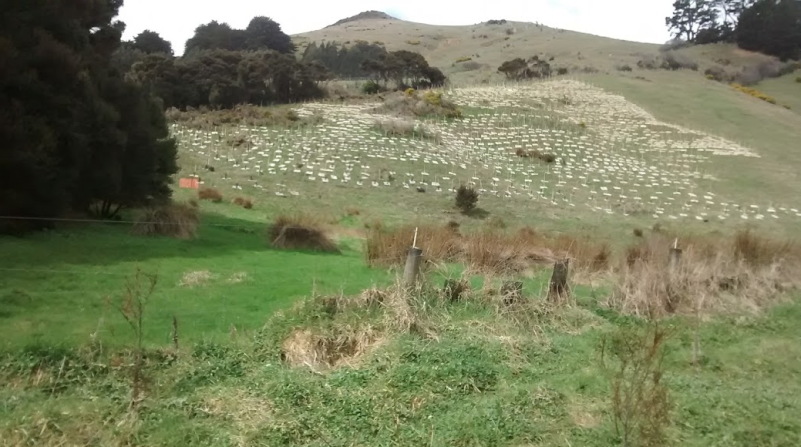
The Future Forest is expected to grow on a patch of farmland bought by the Dunedin City Council in 2013 for development as an outdoor leisure amenity. Financial support for construction materials and for a half-time worker is met by The Otago Community Trust which also granted $17,800 for building equipment and tools such as a container shed and electric wheelbarrows. Further grants to buy trees and also tools and equipment have been made by national companies like Calder Stewart. Other young trees may be bought and donated for a range of reasons such as Citizenship trees or celebrating significant birthdays - seventy and eighty trees are common donations. My wife and I have financed 150 trees this year for our combined significant birthdays.
A group of planting volunteers work regularly once (or more) a week planting and managing the trees, boosted on Sundays from educational groups like university or schools. The project is managed by Save the Otago Peninsula (STOP), a community based environmental group which actively undertakes habitat enhancement, advocacy, and education for the unique biodiversity of the Otago Peninsula. The project manager is Lala Frazer, Dunedin’s “wild hero 2020”, one of the founder members of STOP. Winter is tree planting season, and seedlings for this are grown locally - mostly from seed locally sourced. Having been planted and fertilised, they are protected from weeds by two biodegradable coffee sacks and from rabbits and other mammalian pests by a wire cage. (Talking of mammalian pests, the fertiliser tablets have to be stored in screw-top jars because the dogs of the planters find the blood and bone constituents irresistible.) Two years later, if not sooner, the trees need to be revisited as the grass and other weeds will have overcome the sacks and now be as big as the trees. Mostly the cages will have protected from browsing rabbits very well. Every tree is staked, identified, and monitored over years. The survival rates are really good at 95% – 98%
To move around on this land, footpaths have been created and steadily improved or consolidated first with free pallet material, then more permanently with tanalised boardwalks and steps. I have been asked to undertake building a series of boardwalks following this improvement procedure. As some of these paths cross watercourses, drainage is important for long-term survival of boardwalks. Also, for some years now, I have produced seats which are strategically placed close to concentrations of birthday trees, proving popular by appending the doners’ name to them. Occasionally, seats have been requested as memorials, but it is mostly from people who can read their own names up there. It is not always easy getting to the more remote planting sites, and some seats are used as a focus for morning tea sessions!
Building on my background in tourism, I respect the importance of site interpretation, and to this end I have created and displayed maps. The first displayed the extent of the estate in the wider landscape, the more recent concentrates on planted areas around Smiths Creek catchment and the position and extent of access paths. Many people using the paths for dog walking or leisure have been inspired by what they have seen to join the management volunteers and swell our numbers.
I guess that at the end of the day I must just be a tree hugger.