SENIORS CLIMATE ACTION NETWORK (SCAN)
Limits of Recycling

There is a lot of rubbish written about recycling (pun intended). Life forms on Earth have relied on recycling of minerals for billions of years, but most life forms require dispersal of minerals and nutrients in the form of decaying flora and fauna etc., whereas humans in an industrial society require concentrations of minerals for its technology and the stuff it creates. Georgescu-Roegen in his book "The Entropy Law and the Economic Process" (1971) pointed out that mineral resources required for technology will ultimately become dispersed regardless of our efforts to recycle. 100% recycling is a physical impossibility because higher recycling rates of materials require progressively more energy which ultimately limits the practical level of recycling (Mills 2020).
Figure 1 shows the recycling process and the inevitable energy and material loss to the environment.
Figure 1 shows the recycling process and the inevitable energy and material loss to the environment.

Figure 1: Recycling and Inevitable Energy & Material Loss to the Environment
The neoclassical economic depiction of a circular economy has long ignored the source of energy and materials which enters an economy and the harmful waste and low-grade heat that exits. Some protagonists of a circular economy claim that we can decouple energy and materials from the economy. This claim is a nonsense. There are thermodynamic and physical limits to the extent that the efficiency of processes and recycling can be achieved. By all means we need to reduce the scale of mined resources needed to sustain our economies by making more efficient use of resources, and we also need to reduce the scale of our waste by greater levels of recycling. However, we should call a spade a spade and simply say what we need to do instead of referring to our economies as being a “circular economy” which perpetuates the neoclassical economics misconception that our economies are like self-contained perpetual motion machines.
Figure 2 shows current recycling rates of metals. Only a few metals have a recycling rate of over 50%. According to the United Nations Environmental Programme (UNEP 2011), iron and steel have an end-of-life recycling rate of 70-90%. The recycling rate of lead in the United States reached 76 percent in 2019. These values represent the highest end-of-life recycling rates among all the industrially-used metals. Some rare metals necessary for the production of batteries not only have a very low recycling rate, but are also scarce and are already a supply risk (Michaux 2019).
Figure 2 shows current recycling rates of metals. Only a few metals have a recycling rate of over 50%. According to the United Nations Environmental Programme (UNEP 2011), iron and steel have an end-of-life recycling rate of 70-90%. The recycling rate of lead in the United States reached 76 percent in 2019. These values represent the highest end-of-life recycling rates among all the industrially-used metals. Some rare metals necessary for the production of batteries not only have a very low recycling rate, but are also scarce and are already a supply risk (Michaux 2019).
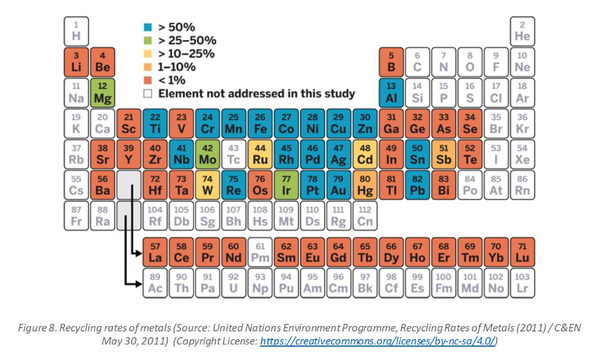
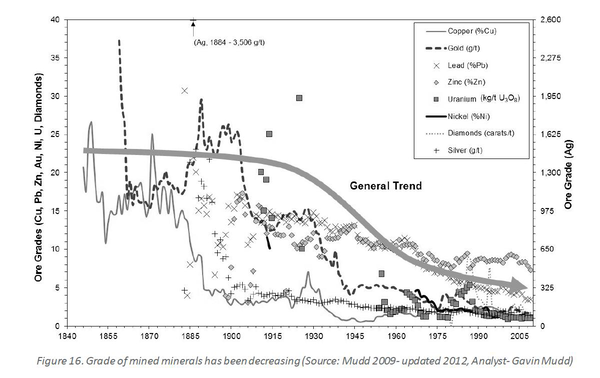
Figure 3: Decreasing Grades of Mined Materials (Mudd 2009, updated Mudd 2012)
Assume that all metals have a recycling rate of 90%. After only 6 and 7 cycles of recycling, 53% and then 48% of the original material is available for reuse. The half-life is therefore, say, 7 cycles. Assume the time in use is 30 years - for example, components of photovoltaic panels and wind turbines. The half-life would then be about 200 years. Every 200 years, the original mined material would be halved. After 1,000 years, there would be only 3% of the original mined material in use. The current rates of recycling of many metals nowhere match 90% and higher rates of recycling do not bode well for the long-term future because higher rates of recycling require progressively more energy than lower rates. Some metals require more energy to recycle than other metals at any chosen rate of recycling.
The converse of half-life is the doubling time, the time for an entity undergoing exponential growth to double in size (see our website page on exponential growth). When use of a resource grows exponentially, the use of resources over the last doubling time is equal to the sum total of use over all previous doubling times. Any growth in the mining of resources compounds the shortening in the time frame during which it is physically possible to mine that resource. A high technological society can be sustained for a longer period when there is no growth in the mining of resources.
The grades of mined materials have steadily decreased, especially since the 1930s as shown in Figure 3. Without extraordinary advances in mining and refining technology, the 10% of world energy consumption currently used for mineral extraction and processing would rise as lower grade and more remote deposits are mined (Mudd 2009). Very low concentrations of minerals and metals are too energy costly to concentrate for use. The energy costs of recycling will eventually exceed that of mining low concentrations of metals and minerals still in the ground. Energy is required for many other purposes other than mining and recycling of minerals and use of energy has a hierarchy of necessary uses. In the long term future, society will need to accept that some minerals are too energy costly to continue using in its technology.
The converse of half-life is the doubling time, the time for an entity undergoing exponential growth to double in size (see our website page on exponential growth). When use of a resource grows exponentially, the use of resources over the last doubling time is equal to the sum total of use over all previous doubling times. Any growth in the mining of resources compounds the shortening in the time frame during which it is physically possible to mine that resource. A high technological society can be sustained for a longer period when there is no growth in the mining of resources.
The grades of mined materials have steadily decreased, especially since the 1930s as shown in Figure 3. Without extraordinary advances in mining and refining technology, the 10% of world energy consumption currently used for mineral extraction and processing would rise as lower grade and more remote deposits are mined (Mudd 2009). Very low concentrations of minerals and metals are too energy costly to concentrate for use. The energy costs of recycling will eventually exceed that of mining low concentrations of metals and minerals still in the ground. Energy is required for many other purposes other than mining and recycling of minerals and use of energy has a hierarchy of necessary uses. In the long term future, society will need to accept that some minerals are too energy costly to continue using in its technology.
A balance of longevity in use and the rate of recycling is necessary to reduce the energy costs of keeping minerals and metals in use over each generation of the population. This balance needs to be weighed up against the energy costs of mining for new minerals and metals and the extent of their scarcity.
Figure 2: Recycling Rates of Metals (Michaux 2019)

Metals and minerals which are ultimately dispersed to the environment after use represent the loss of resources which cannot be used by future generations. If our species of humankind should continue to exist in the far distant future, then future levels of technology will inevitably decline due to the inability to concentrate dispersed minerals and metals. Humans will have the choices of accepting a declining level of technology and a corresponding declining physical consumption standard of living or reducing their population to maintain the same per capita use of minerals. Ultimately, the prospect for humans is a return to being hunter-gatherers. This life style does not necessarily need to be brutish and short so long as humans in the distant future are able to retain essential repositories of knowledge.
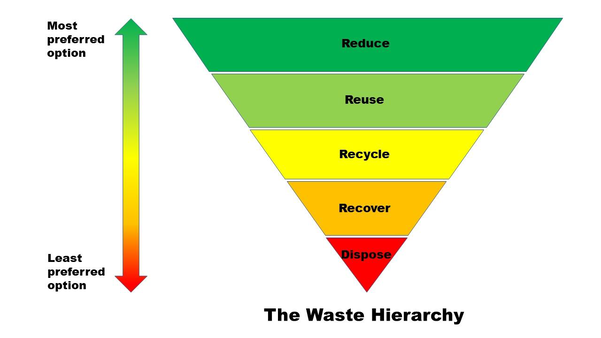
Our focus is on the shorter-term future, and especially the next number of decades, where our actions or lack of actions will largely determine the future of our children’s grandchildren. Figure 5 shows the waste hierarchy of human settlements. Actions further up the hierarchy reduce impacts on the environment and enable a higher level of technology for future generations.
Our focus is on the shorter-term future, and especially the next number of decades, where our actions or lack of actions will largely determine the future of our children’s grandchildren. Figure 5 shows the waste hierarchy of human settlements. Actions further up the hierarchy reduce impacts on the environment and enable a higher level of technology for future generations.
Disposal of some waste is inevitable. For modern civilisations to exist at a technology level way beyond the stone tools of the hunter-gatherer, there will always be waste which flows out of the economy into the environment. The environment can accommodate a degree of waste, but we need to ensure the level of our waste does not exceed the environment's capacity to assimilate that waste. We need to use benign technology. We also need to question whether higher levels of technology provide greater levels of happiness and wellbeing.
Before accepting disposal of materials, we should Recover and Repurpose materials as much as possible, followed by Recycling and Reusing materials in a replacement or different form. The most effective way to reduce waste is to Refuse to use materials for unnecessary and extravagant purposes. By doing so, we Reduce our use of materials.
REFERENCES
Georgescu-Roegen N. (1971) The Entropy Law and the Economic Process. London, Harvard University Press, 457 pp.
Michaux, S.P, (2019), The Mining of Minerals and the Limits to Growth, Geological Survey of Finland. https://www.researchgate.net/publication/351712079_The_Mining_of_Minerals_and_the_Limits_to_Growth
Mills, M.P. (2020) Mines, Minerals, and “Green” Energy: A Reality Check. Manhattan Institute. https://www.manhattan-institute.org/mines-minerals-and-green-energy-reality-check
Mudd, G. (2009), Historical Trends in Base Metal Mining: Backcasting to Understand the Sustainability of Mining, Proceedings 48th Annual Conference of Metallurgists, Canadian Metallurgical Society, Sudbury, 2009 August. Update by Mudd, 2012.
UNEP (2011) Assessing Mineral Resources in Society: Metal Stocks & Recycling Rates. https://www.resourcepanel.org/reports/recycling-rates-metals
ADDITIONAL READING
Allwood, J. and J. Cullen. (2012) Sustainable materials with both eyes open. http://www.withbotheyesopen.com
“This evidence-based survey presents a holistic vision of options for a sustainable future by going beyond efficient and clean production to the inclusion of material efficiency and the reduction of demand. Beginning with an all-encompassing examination of the uses of the five most important materials—steel, aluminium, cement, plastic, and paper—this exploration delves into the entire lifecycle of these materials, from smelting and goods manufacture to final recycling. Through evidence drawn from this analysis and real-world commercial enterprises, the study submits creative solutions for achieving manufacturing efficiencies and the same functionality or services using less material, and identifies potential economic outcomes from these scenarios.”
Before accepting disposal of materials, we should Recover and Repurpose materials as much as possible, followed by Recycling and Reusing materials in a replacement or different form. The most effective way to reduce waste is to Refuse to use materials for unnecessary and extravagant purposes. By doing so, we Reduce our use of materials.
REFERENCES
Georgescu-Roegen N. (1971) The Entropy Law and the Economic Process. London, Harvard University Press, 457 pp.
Michaux, S.P, (2019), The Mining of Minerals and the Limits to Growth, Geological Survey of Finland. https://www.researchgate.net/publication/351712079_The_Mining_of_Minerals_and_the_Limits_to_Growth
Mills, M.P. (2020) Mines, Minerals, and “Green” Energy: A Reality Check. Manhattan Institute. https://www.manhattan-institute.org/mines-minerals-and-green-energy-reality-check
Mudd, G. (2009), Historical Trends in Base Metal Mining: Backcasting to Understand the Sustainability of Mining, Proceedings 48th Annual Conference of Metallurgists, Canadian Metallurgical Society, Sudbury, 2009 August. Update by Mudd, 2012.
UNEP (2011) Assessing Mineral Resources in Society: Metal Stocks & Recycling Rates. https://www.resourcepanel.org/reports/recycling-rates-metals
ADDITIONAL READING
Allwood, J. and J. Cullen. (2012) Sustainable materials with both eyes open. http://www.withbotheyesopen.com
“This evidence-based survey presents a holistic vision of options for a sustainable future by going beyond efficient and clean production to the inclusion of material efficiency and the reduction of demand. Beginning with an all-encompassing examination of the uses of the five most important materials—steel, aluminium, cement, plastic, and paper—this exploration delves into the entire lifecycle of these materials, from smelting and goods manufacture to final recycling. Through evidence drawn from this analysis and real-world commercial enterprises, the study submits creative solutions for achieving manufacturing efficiencies and the same functionality or services using less material, and identifies potential economic outcomes from these scenarios.”
Figure 5: The Waste Hierarchy
Figure 4: Balancing Rate of Recycling & Longevity Against Mining for Minerals & Metals